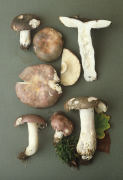
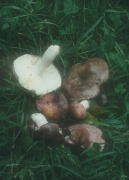
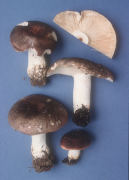
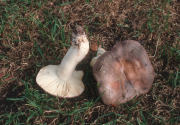
Russula cyanoxantha (Schaeff. ex Secr.) Fr. Frauentäubling, Russule charbonničre, Charbonničre, Charcoal Burner. Cap 5–15cm across, first globose, later flattening to depressed at the centre, sometimes one colour but usually a mixture, dullish lilac, purplish, wine-coloured, olive, greenish or brownish, sometimes entirely green (var. peltereaui), firm to hard, greasy when moist, with faint branching veins radiating from centre, half peeling. Stem 50–100 x 15–30mm, white, sometimes flushed purple, hard, giving no or a slightly greenish reaction when rubbed with iron salts not salmon as in most Russulas. Flesh white. Taste mild. Gills adnexed to slightly decurrent, whitish to very pale cream, rather narrow, oily to the touch and flexible, not brittle as in most Russulas, forked at times. Spore print whitish (A). Spores broadly elliptic, with low, up to 0.6µ high warts; fine lines absent, 7–9 x 6–7µ. Cap cystidia scattered, small, short and narrow (2–4µ), cylindrical, teat-ended. Habitat under broad-leaved trees. Season summer to late autumn. Very common. Edible – good.(Never eat any mushroom until you are certain it is edible as many are poisonous and some are deadly poisonous)Distribution, America and Europe. |